
Thomas Eayre (1691–1757)

From a small workshop in Kettering, Thomas Eayre helped shape the sound of Northamptonshire. He was not only a bellfounder, but also a skilled clockmaker, surveyor and mapmaker, blending precision engineering with artistry.

Kettering heritage Over 200 bells survive 18th century craftsmanship Clocks, bells and maps

In brief

Born in 1691, Eayre became one of the county’s most important craftsmen. His bells still ring from church towers across Northamptonshire and beyond.

Bellfoundry Lane

The name is not an accident. The lane marks the site of Kettering’s bell foundry, where Eayre’s work once set the rhythm of local life.

The story

A local life with a lasting echo.
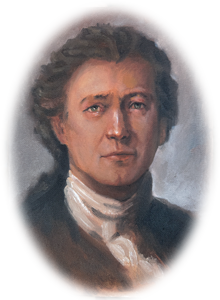
Portrait of Thomas Eayre by Daniel Kelly
Portrait by Daniel Kelly

Thomas Eayre is one of the most remarkable figures in the history of English craftsmanship during the early eighteenth century. Born in 1691 in Kettering, Northamptonshire, he was part of a family rooted in mechanical and practical trades. While earlier generations worked as blacksmiths and clockmakers, Thomas would go on to become known for exceptional skill across bellfounding, clockmaking and surveying.

Eayre began his working life as a clockmaker and repairer, producing and maintaining precision timepieces for local gentry and parish churches. His reputation for careful workmanship was matched by artistic talent. He was a capable draughtsman and surveyor, and he produced detailed drawings and mapping that reflect the same attention to accuracy found in his metalwork.

Around 1717, Thomas and his brother Joseph established a bell foundry in Kettering. Over the decades that followed, the foundry cast well over 200 bells for churches across Northamptonshire and neighbouring counties. Many of these bells were inscribed with traditional phrases and dates, and a significant number remain in use today, continuing to mark weddings, celebrations, and moments of remembrance.

The bells produced in Kettering were admired for their quality and tone. Eayre’s work helped preserve a distinctive English tradition of bellfounding, combining established methods with the practical innovations of a gifted engineer. After his death in 1757, the business continued briefly through the family, but the Kettering foundry eventually fell silent. The legacy did not. The sound of Eayre bells still carries across the county, linking modern communities to the hands and tools of an eighteenth century workshop.

Highlights

Here are some useful snippets.

What he did

  • Cast church bells for Northamptonshire and surrounding counties.
  • Worked as a clockmaker and repairer, including church timepieces.
  • Produced surveying and mapping work, combining craft and measurement.
  • Left a legacy that can still be heard in ringing towers today.

Why it matters

  • Eayre’s bells are part of Kettering’s industrial and cultural history.
  • They connect places through a shared soundscape, across centuries.
  • The story shows how skilled local trades shaped wider regional life.
  • Bellfoundry Lane still marks the site of this important craft.

Watch the video

Please take a moment to watch this video, it explains about the life and work of Thomas Eayre.

Thanks to Adam Cann for the video.

Portrait of Thomas Eayre

Portrait of Thomas Eayre by Daniel Kelly
Portrait by Daniel Kelly

No known portrait of Thomas Eayre has survived, and of course he lived in a time long before photography could preserve a face for future generations. Although his bells, clocks, maps and inscriptions remain, the features of the man himself were lost to time.

The portrait shown here is therefore an artistic interpretation, created by local artist Daniel Kelly as an attempt to imagine the face behind the work. It draws not from a single image, but from fragments of historical evidence, the period in which Eayre lived, the character suggested by his craftsmanship, and the world he inhabited in eighteenth century Kettering.

The piece was developed through collaboration between Daniel and local historian Adam Cann, combining artistic instinct with historical research to arrive at a likeness that feels rooted in the age, even if the exact face can never be known.

In that sense, the portrait is less a claim of certainty than an act of careful imagination, offering Thomas Eayre back to the town not as a fixed truth, but as a thoughtful possibility.

Why This Project Happened

This project began with a simple idea, that Bellfoundry Lane should tell its own story.

Although thousands of people pass through the lane each year, very few realise that its name comes directly from one of Kettering’s most remarkable former residents, Thomas Eayre, the eighteenth century bellfounder, clockmaker, cartographer and craftsman whose work helped shape both the town and its history.

The idea was brought forward by Adam Cann, local historian and Secretary of Kettering Cleaning Club, who felt that this small corner of the town deserved something that connected the present day street with the extraordinary history beneath it. Inspired by the story of Thomas Eayre, the aim became not simply to improve the lane visually, but to give people a reason to pause, look, and discover who once worked here.

The project has combined local history, creative design and voluntary community effort. Alongside helping shape the historical interpretation, Adam also created the short film featured on this page, bringing together archive material, present day images and storytelling to help make the history of Bellfoundry Lane more accessible to everyone.

What began as a conversation about one forgotten lane has grown into a small act of restoration, helping reconnect Kettering with one of its own remarkable stories.